About
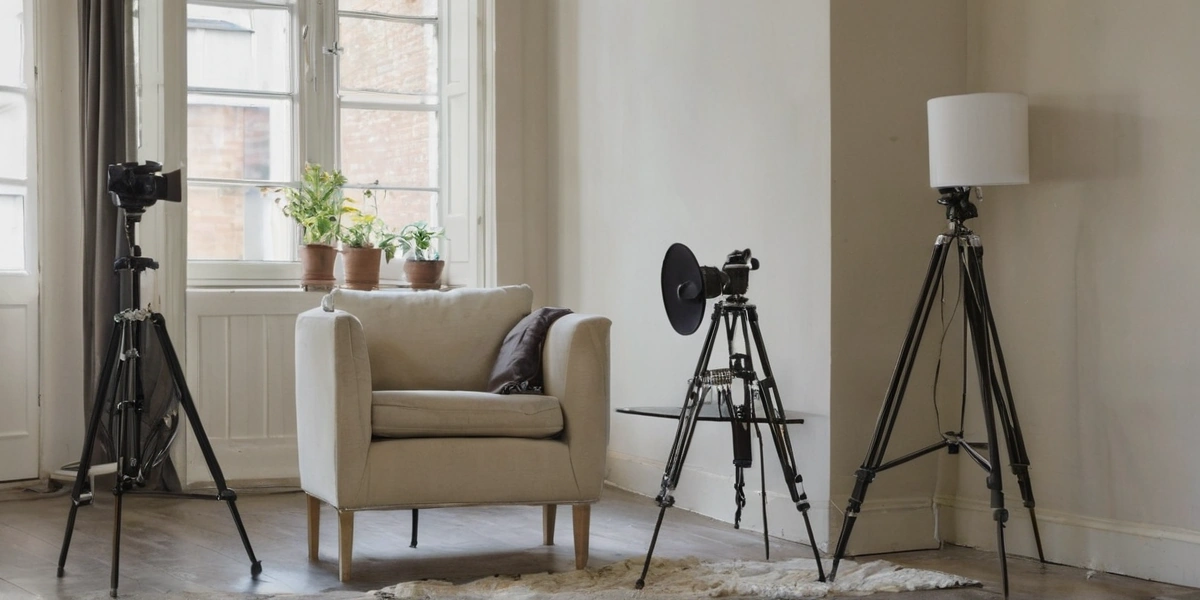
Barbara Brown photographs interiors from a studio in Bristol and has worked in interiors since 2011. Barbara Brown's clients are architects recording finished projects, furniture makers showing pieces in real rooms, and three letting agencies that send roughly 40 properties a year. Six years spent specifying kitchens as an interior designer before 2011 is where the habit of clearing a 3.2m worktop down to two objects comes from.
How does a shoot day run from arrival to the last frame?
A shoot day covers one property and six to nine finished frames, running 09:00 to 17:15 in a three bedroom flat. Preparation takes 300 minutes and shooting takes 150 minutes, a two to one split. Room order follows daylight: a west facing kitchen goes last, and a north facing bathroom can be shot at any hour.
| Start | Stage | Minutes | Output |
|---|---|---|---|
| 09:00 | Walkthrough, running order set by daylight | 20 | 8 angles listed |
| 09:20 | Strip five rooms into crates | 100 | 5 rooms cleared |
| 11:00 | Clean glass, taps, hobs, mirrors | 45 | no retouching backlog |
| 11:45 | Style, steam curtains, make beds | 155 | 8 frames dressed |
| 14:20 | Shoot 8 angles, three frame brackets | 150 | 24 raw files |
| 16:50 | Tethered review with the client | 25 | selects agreed |
A north facing bathroom holds its light because a north window changes by under half a stop between 10:00 and 16:00 under settled cloud. A west facing kitchen gains 1.5 stops across the same window and goes last on the list for that reason. Full detail on reading the sky sits in the note on overcast daylight.
What kit does Barbara Brown carry to an interior shoot?
The working kit runs to one body, three lenses, one tripod and a styling box in a single case. Barbara Brown shoots a 45 megapixel full frame body at base ISO 100, tethered to a laptop so a client sees an 8200 by 5500 pixel frame on screen rather than a 3 inch back screen.
- Full frame body, 45.1 megapixels, 8200 by 5500 pixels, 4.4 micrometre pixel pitch.
- 24mm shift lens with 12mm of rise, used at 6mm to 8mm on almost every room frame.
- 35mm and 50mm primes, worked at f/8 and f/11 for wall frames and furniture details.
- Geared head on a carbon tripod reaching 152cm without the centre column extended.
- Grey card, spirit level, one 2700K practical lamp, a steamer and a 60 litre crate.
Artificial lighting appears in under one frame in twenty. Daylight through a 1.4m window at EV 7 renders a room with softer shadow edges than a speedlight bounced off a 2.4m ceiling, and daylight leaves the wall colours reading at the Kelvin value the architect chose them under.
What happens to a file between the card and delivery?
Each angle leaves the card as three 14 bit raw files of 52 to 58 MB carrying 16,384 tone levels per channel. The three frames merge to one 16 bit TIFF of about 270 MB, so eight angles occupy roughly 2.2 GB before a single delivery file is written. White balance comes from the grey card frame.
Retouching stays inside a short list: a socket cover no styling could hide, a stray cable, dust on a dark floor, and a fingerprint on a shower screen. Walls are not repainted in software and furniture is not added after the shoot, because an architect commissioning a record of a finished project needs the record to match the building.
Delivery covers two file sets per angle. Web files run 2400 pixels on the long edge at quality 80, about 1.1 MB each, sized for a letting agency listing. Print files run full resolution 8 bit TIFF at about 135 MB each, in sRGB unless the client asks for Adobe RGB.
What does a booking with Barbara Brown include?
A booking covers preparation, shooting and 8 edited frames delivered within 5 working days, at a day rate quoted per property. Travel inside 40 miles of Bristol carries no extra charge. Additional angles beyond eight are quoted at the per angle preparation and shooting times listed in the note on styling a room.
Send an email to [email protected] with the address, the room count and the date. A reply comes back with a running order keyed to that property's window orientations and a preparation list naming what to remove from each room before 09:00.
The journal records the parts of the job worth writing down: reading overcast daylight, keeping verticals plumb, and picking a focal length that describes a room at its real size.