Shooting interiors in overcast light
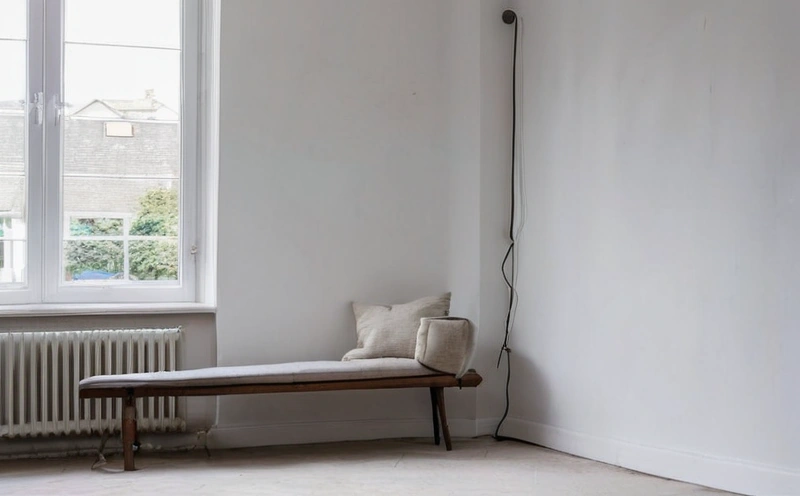
Overcast daylight is the light Barbara Brown books for, not the light left over when the sun fails. A white sky turns the whole street frontage into one soft source, and the physical size of that source is what makes overcast daylight useful indoors. Direct sun through a south facing sash lays a floor patch that meters EV 12 at ISO 100 while the wall behind the sofa sits at EV 6, a 6 stop split that no single raw frame holds with clean shadows and unclipped highlights. Flat cloud brings the same room to a 2 stop range across the same two surfaces, and a 2 stop range leaves every tone well inside one 14 bit file.
Why does flat cloud narrow the contrast range in a room?
Flat cloud narrows the brightness range inside a 4.2m by 3.6m Bristol living room from roughly 5 stops to roughly 2 stops, measured between the plaster wall furthest from the window and the painted sill beside the glass. Cloud also holds the level steady across the 40 seconds a three frame bracket takes, so the merge shows no banding.
Shadow edges tell the difference before a meter does. The sun subtends 0.53 degrees, so a chair seat 450mm above bare boards casts a shadow edge about 4mm wide in direct sun, hard enough to read as a black shape welded to the leg. The same chair seat lit by a 1.4m wide window 2m away casts a shadow edge about 315mm wide, which still separates the chair from the floor without drawing a line around the chair.
Broken sun ruins brackets. A room lit through moving cloud can shift 2 stops between the first frame and the third frame of a bracket, and the merge writes that shift as a bright band across one wall. Under settled cloud the three frames differ only by the shutter speeds set on the dial: 1 second, 1/4 second and 4 seconds at f/11 and ISO 100.
Heavy grey sky costs modelling. A north facing bedroom with a single 900mm by 1200mm sash under complete cloud cover can read flat across the whole back wall, with under half a stop between the corner nearest the window and the corner furthest from the window. Two fixes work in that bedroom. Switching on one 2700K practical lamp in the far corner and exposing 1/3 stop down protects the shade from clipping, or moving the tripod to within 1.5m of the window wall puts about 2 stops of falloff between the near wall and the far wall.
What does an interior meter at under an overcast sky?
A Bristol interior under settled cloud meters between EV 5 and EV 8 at ISO 100, which runs from 4 seconds to 1/2 second at f/11. Barbara Brown sets f/8 for a room under 12 square metres, f/11 for any frame with furniture inside 1.5m of the front element, and base ISO 100 throughout.
The window is the brightest object in almost every interior frame and the window is almost never the subject. A meter reading taken off the glass underexposes the room by 3 to 4 stops. Barbara Brown meters the wall furthest from the window, places the plaster tone at about 70 per cent of histogram width, and lets the glass clip in the base frame.
Three frames at 2 EV spacing cover about nine rooms in ten. The base frame holds the plaster, minus 2 EV holds the sky through the glass on a dull day, and plus 2 EV opens the inside of an unlit wardrobe. A garden under bright cloud needs a fourth frame at minus 4 EV. Five frames at 2 EV spacing earn their keep only in a stairwell, where the drop from rooflight to bottom step reaches 7 stops.
| Sky condition | Meter reading | Shutter at f/11 | Bracket frames | Custom white balance |
|---|---|---|---|---|
| Bright overcast, thin cloud | EV 8 | 1/2 second | 3 at 2 EV | 6200K |
| Settled grey, full cover | EV 7 | 1 second | 3 at 2 EV | 6600K |
| Heavy rain cloud | EV 6 | 2 seconds | 3 at 2 EV | 7200K |
| North room, deep shade | EV 5 | 4 seconds | 5 at 2 EV | 7800K |
| Broken sun through cloud | EV 6 to EV 10 | 2 seconds to 1/8 | none, wait | unstable |
Which Kelvin value corrects daylight mixed with 2700K lamps?
Overcast daylight through domestic glass measures 6200K to 7600K, and a north facing room in deep shade reads past 8000K. Barbara Brown shoots one grey card frame per room and sets a custom value near 6600K with a magenta shift of 5 to 10 units.
Auto white balance is the wrong tool for a plastered room. Auto white balance reads a large area of white plaster as a cold subject and commonly lands 400K away from the grey card value, which puts a magnolia wall 8 units green in a 6600K room.
Colour temperature adds and subtracts in mireds rather than in Kelvin, which is why a half correction never looks half corrected. Daylight at 6600K sits at 152 mireds and a 2700K tungsten lamp sits at 370 mireds, a gap of 218 mireds. A full CTB gel shifts a source by about 131 mireds, so a full sheet taped over a table lamp still leaves 87 mireds of orange against the daylight.
| Source in the room | Colour temperature | Mired value | Gap to daylight |
|---|---|---|---|
| Overcast daylight through glass | 6600K | 152 | reference |
| Daylight balanced LED panel | 5000K | 200 | 48 mireds |
| Neutral LED downlight | 4000K | 250 | 98 mireds |
| Halogen downlight | 3000K | 333 | 181 mireds |
| Tungsten or warm white lamp | 2700K | 370 | 218 mireds |
| Candle flame | 1900K | 526 | 374 mireds |
Two clean routes exist for a room holding both daylight and lit lamps. Switching every fitting off keeps one colour temperature in the file and suits an empty property, and switching off takes about 2 minutes in a flat with 14 fittings. Shooting the angle twice, once with lamps off and once with lamps on, lets the lamp glow be painted back at 30 to 40 per cent strength inside a 300mm radius of the shade. The second frame costs 10 seconds on site and saves about 20 minutes of masking at the desk.
How long should a photographer wait for the sky to settle?
An overcast sky can lift the indoor level by 1.5 stops in 20 seconds as a thin patch crosses the sun, then drop the level back inside a minute. Barbara Brown watches the meter for a full 60 seconds before the first frame, and waits 5 to 10 minutes whenever the reading swings by more than half a stop.
Reshooting an angle at the end of a shoot costs about 15 minutes: the tripod goes back up, the height gets reset, and the styling that was pushed aside for the next room gets rebuilt. Waiting 8 minutes at the tripod costs 8 minutes. The arithmetic favours waiting on every job with more than four angles booked.
Winter closes the working day early. In Bristol in January the indoor level falls below EV 6 after 15:30, and by 16:00 an f/11 frame needs 4 seconds or longer, long enough for a curtain to drift in a draught and smear across 20mm of frame. Barbara Brown books interiors between 10:00 and 15:00 from November to February, and between 09:00 and 17:00 from April onward.
What order does an overcast interior angle run in?
Barbara Brown works a single angle in five steps that take 6 to 9 minutes once the room is styled: choose the angle on foot, meter both end walls, set ISO 100 with a grey card white balance, shoot a three frame bracket at 2 EV spacing, then read the darkest corner at 100 per cent magnification.
- Walk the room and choose the angle before the tripod leaves the bag.
- Meter the wall furthest from the window, then the sill beside the glass.
- Set ISO 100, f/11, and a custom white balance read from a grey card.
- Shoot the base frame, then minus 2 EV, then plus 2 EV, then minus 4 EV for a bright garden.
- Check the darkest corner at 100 per cent on the back screen before moving.
A grey afternoon on a levelled tripod at 1 second and f/11 produces a cleaner file than a bright morning at 1/60 handheld. The variable that follows the light is where the camera stands and how plumb the sensor sits, which is the subject of the note on correcting verticals.